
A Happy Family

All happy families are alike; each unhappy family is unhappy in its own way. - Leo Tolstoy
While I’ve written essays and I’m working on a family memoir about my paternal family, I’ve written almost nothing about my maternal family. How does one write about a happy family? In a way that shows that not all happy families are alike? In a way that contains some tension to propel the narrative forward? The common conception as far as storytelling goes is that happy families lack conflict and therefore are boring.
When I think about my maternal family, I think about our annual reunions camping on the Rogue River or along the Oregon coast. For over forty years, we have chosen to spend a week together in the summer. My mother has seven siblings; I am one of twelve grandchildren. Add to that five of my mother’s first cousins, and everyone’s spouses, children, grandchildren, and now great-grandchildren. Our reunions number from seventy to over a hundred of us. Our ages span the years from one to eighty-five.
Can you picture such a gathering? Sunlight slanting through the towering pine trees. Children spilling out of cars and campers. Greetings full of smiles and hugs. Tents raised. The hiss of air filling inflatable kayaks. Laughter around the campfire. Hands sticky from s’mores.
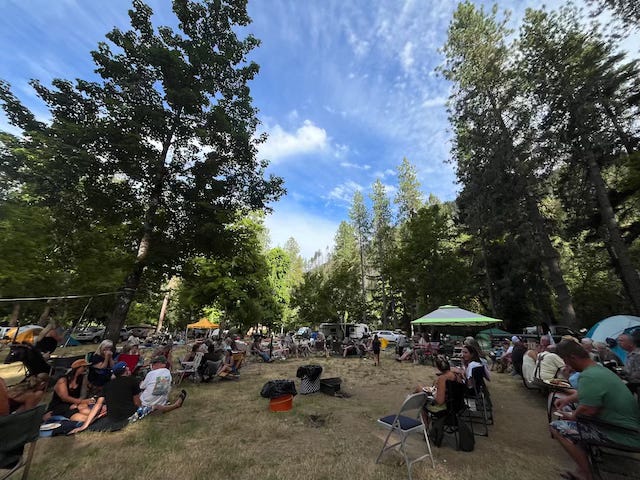
But what during that week of nonstop family time is of interest to a reader? Potlucks, bingo games, and sing-alongs (a family favorite!)? Rafting down the Rogue? Corn hole bags smacking? Bocce balls clacking? Endless rounds of double (or quadruple or more!) solitaire, Scrabble, Boggle, and whatever the favorite games are for that particular year? Children riding their bikes around the camping circle always in sight of one family member or another?
My maternal family is, of course, not only a happy family but a family filled with the breadth and depth of human experiences and emotions. But whenever I think about putting this family on the page, the reunions are what come to mind.
All of which is to say I’m grateful for my maternal family, even if they don’t provide me with much grist for the mill.
And to answer Tolstoy’s quote, I would say that families who enjoy spending time together may be similar, but where they spend and what they do during that time reveals their individuality.
I did write this piece about river rafting seven years ago, which gives a glimpse of my maternal family, though it is mostly about me.
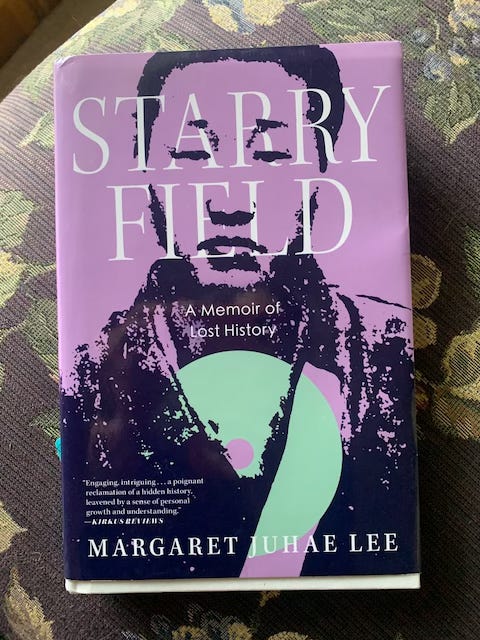
Books: In Starry Field: A Memoir of Lost History by Margaret Juhae Lee, the author is seeking information about her grandfather who as a student protested Japanese rule in colonial Korea. In addition to being thematically related to my search for my Armenian grandmother’s life in the Ottoman Empire during the Genocide, Starry Field is a good structural model for me. I noticed how Lee broke up big chunks of history to keep the narrative flowing. How she didn’t stick to a strict chronological order of events. How she presented her interviews with her grandmother in between other parts of the story, which created suspense.
What book has held your attention this month?
Work-in-Progress: I finished restructuring and revising the first nineteen pages of my Armenian family memoir. For now I’m leaving it as one long segmented section. Next I’m researching and revising a chapter on the American Mission and its role in the Ottoman Empire and during the Armenian Genocide.
Would you write about your family? Is there a branch of your family that might be more interesting to research and write about? I’d love to hear your thoughts in the comments.
Thank you for reading! Writing is a lonely endeavor and your presence here brightens my day!
It’s a Good Day . . . to spend time with your family!
I am in the same boat - I have written almost nothing about my mother’s family! I feel like there is little to discover about them since they have extensive information about their ancestors. My father’s family, in the other hand, remains such a mystery that it compels me to keep digging into that story.
I've been reading Elizabeth Strout's latest novel The Things We Never Say--a great novel for thinking about family! There's something about Strout's straightforward, no-nonsense way of telling stories that I find quite compelling and easy to read.